
風の旅人 第48号「死の力〜来し方、行く末 memento mori」2014年6月1日発行
Author: 佐伯剛 Tsuyoshi Saeki(編集長)
Translated from the Japanese, October 2026.
Ikeya drew that boundary state out of the abstract by using the water as his instrument — and fixed it, in the darkroom sense of the word, in his photographs.
Ikeya drew that boundary state out of the abstract by using the water as his instrument — and fixed it, in the darkroom sense of the word, in his photographs.
Part One — the editor's text
Forgotten Breath,
Remembered Life
Tsuyoshi Saeki — Editor in Chief, The Wind Traveller
Breath is a precondition of human life — yet on dry land we forget that we are breathing. And just as we forget our breathing, we forget the worth and the meaning of being alive. Standing in the narrow interval between life and death, a person remembers what had been almost entirely forgotten. Sometimes it cannot be recalled until the very threshold of death; and there are cases in which, in the instant of remembering, life ends. To know life without knowing death is not possible. The art of knowing death while one is still alive may be, for a human being, the deepest of secrets.
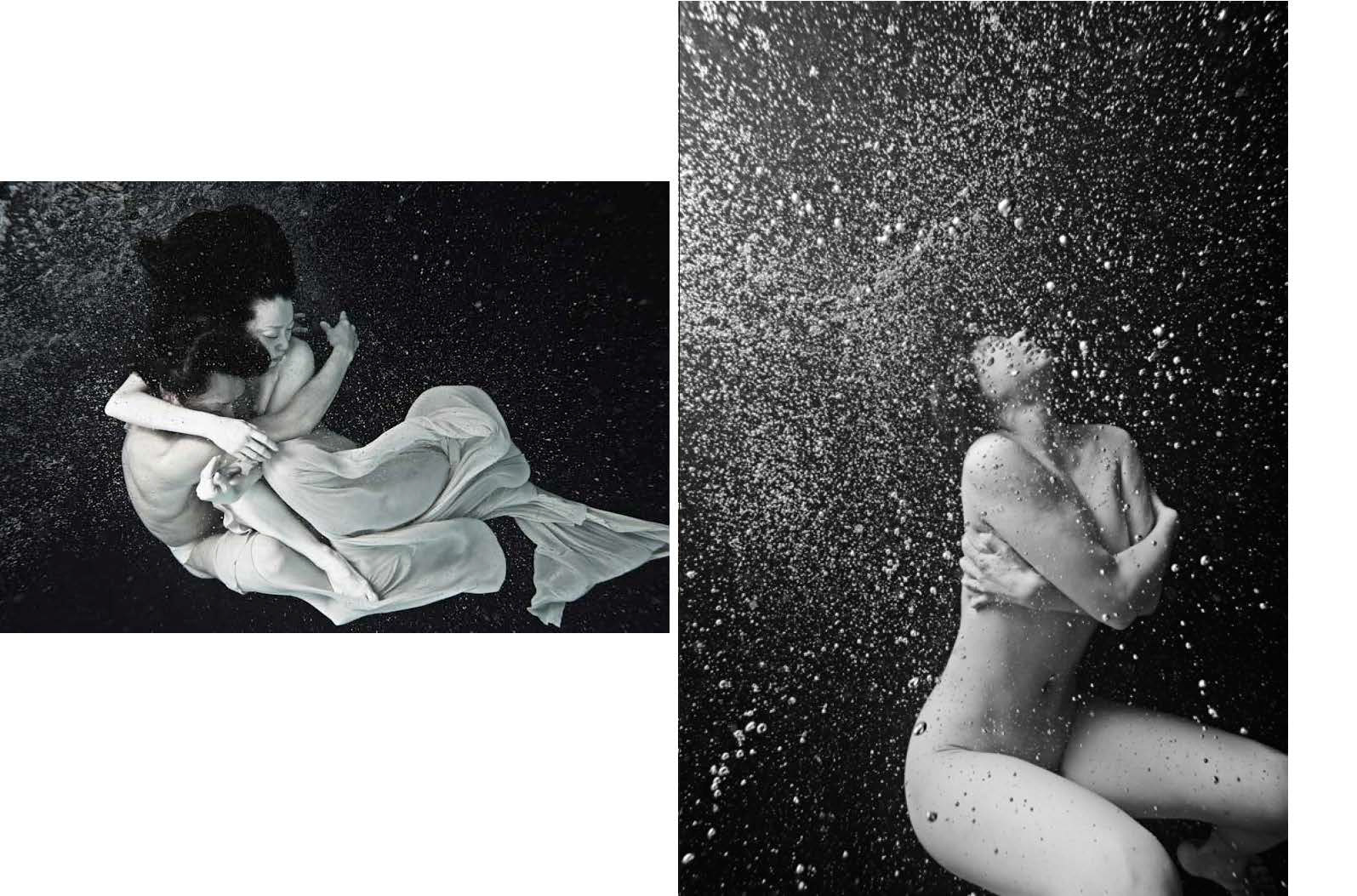
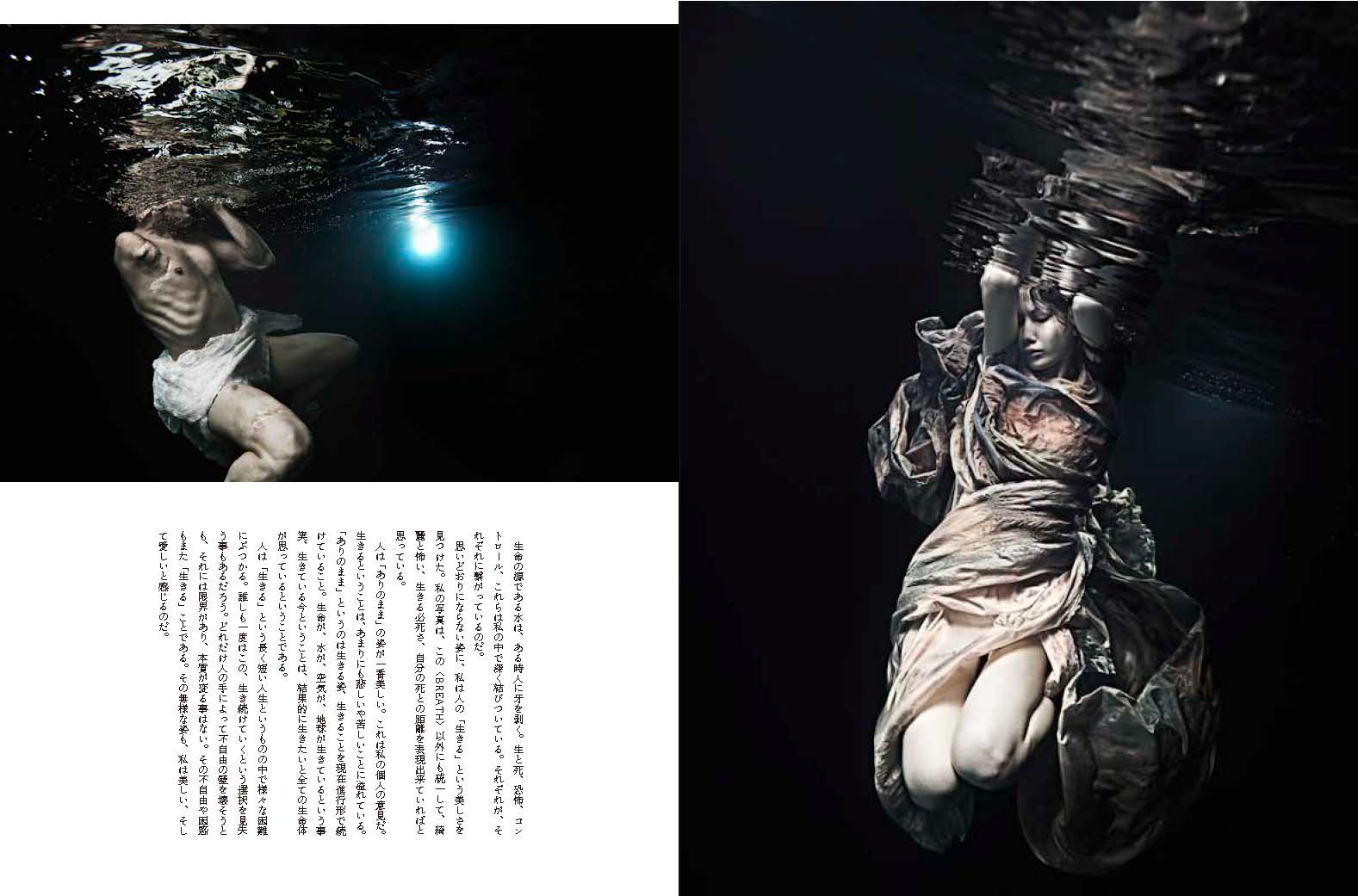
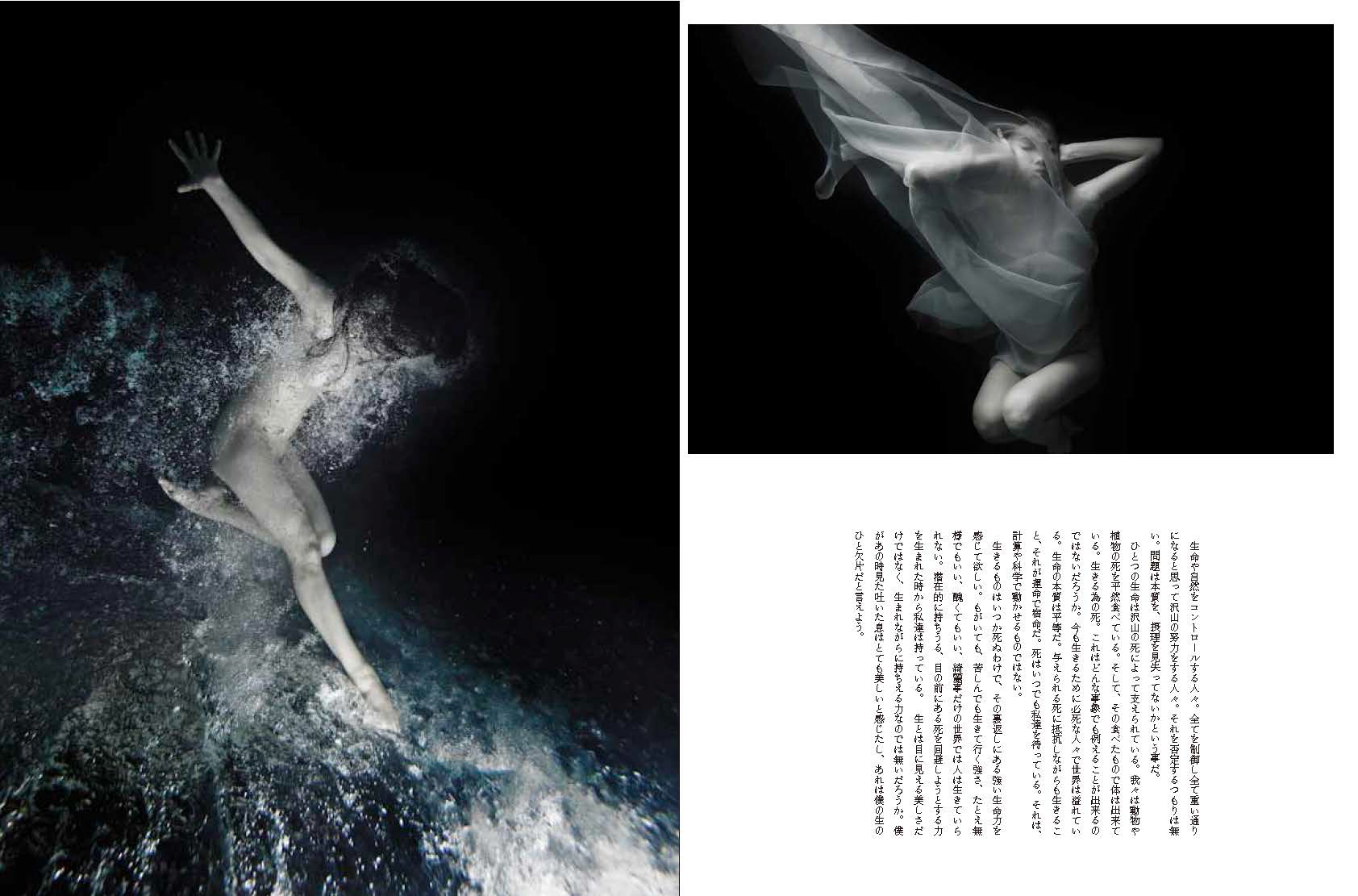
The photographer Tomohide Ikeya, who in recent years has begun to draw attention abroad, has continued to work under the theme BREATH. He dives into the water — that threshold between life and death, where a human being is far more constrained than on land — without so much as a scuba tank, and photographs the human figure at its limit. His models hold their breath for roughly thirty seconds to a minute. Ikeya himself stays under for as long as two minutes, swimming alongside them, struggling with his own need for air as he shoots.
People living with disabilities, too, have come forward of their own accord to model for these underwater photographs.
Standing at the boundary between life and death, one feels more keenly the preciousness of being alive — and the force of life that strives against the death bearing down. Everyone has known this once or twice in a lifetime. But the dull repetition of days, and the hardening of the world's common sense, make us forget it.
Ikeya has drawn that boundary state out symbolically, using the water as his instrument, and fixed it in his photographs. Looking at these photographs, one may remember the force of life that lies asleep in one's own memory.
— Tsuyoshi Saeki, The Wind Traveller No. 48, "The Power of Death," 1 June 2014
Part Two — from the editor's page
Born, born, born, born
From the editor's page
Beneath the theme of the forty-eighth issue of The Wind Traveller —
"The Power of Death: what lies behind us, what lies ahead —
memento mori" — runs this sentence of Kūkai's.
Born, born, born, born —
dark at the beginning of life. Dying, dying, dying, dying —
dark at the end of death.
— Kūkai, Hizō Hōyaku (The Secret Treasure of the Precious Key)
To be born and to live is, more often than not, painful and sad. And it is settled that we must die. Life after life is born, and every one of them dies. And still more life is born. If dying is settled upon us, and if living is suffering — then why are we born at all? However many die, however bitter and grief-stricken it is, life keeps being born. Born without end, and all of it dying. And born again. Forever repeated. Life carries death within it, and death carries life. In that last, straining contact between the two lies the essence of a life.
With the wish that something of this might surface through the pages of the magazine, I have worked at it for the past six months. Whether I have managed it — with a theme this absolute, I do not know. But it is a theme one must take on at least once. Everyone's bookshelf holds a variety of books; I think it is all right for one of them to be a book like this.
— From the editor's page, The Wind Traveller No. 48




Part Three — the artist's text
The Figure That Will Not Go as One Wishes
TOMOHIDE IKEYA
I only began to feel "life and death" as something real after I had entered deeply into the world of water. That was long before I ever picked up a camera.
The first time I saw the world inside the water — on a dive I had been invited on by chance — it took my heart in an instant. You throw yourself into that vast world and go on alone through a blue that continues without end. Even when I dive with companions, the sense of being alone is strong under the sea, and I am stirred by phenomena that occur nowhere but in water. Beautiful phenomena woven from living things, water, and light. Scenery. Seeing it with my own eyes, I felt in my body a strong elevation, an excitement, a feeling I could not put into words.
Everything was fresh and outside ordinary life. Even when I could not swim well, the bubbles of my breath drifted after me, fleeting. They showed me how utterly unreliable the oxygen inside my body was. And while I felt, sharply, the thinness and the limit of my own existence, I wanted to go on looking at the beauty in front of me forever. This scenery I burned into my eyes as if in haste — would it still be here, always?
Diving made stronger in me the grief I feel at natural beauty being lost, at beauty being destroyed. For my part, though, I always feel a sense of relief and safety in having my whole body wrapped in water.
But the sea, which is the source of life — this water that is also inside our bodies — sometimes takes a human life.
The sea gives birth to people and kills them. And people pollute the sea, and damage the relationships among the life that unfolds there. Is this a tragedy that will repeat forever, or a providence there is no escaping?
In water you can hardly walk as you do on land. Depending on the weather it will not even permit you to enter. We who are residents of dry land need a great deal of training and careful preparation to enter the domain of water. The land is surrounded by the sea; the world of water spreads out just beside us, and yet inside it the common sense of dry land is of no use at all.
The above-ground world of today dislikes constraint, wants everything to go as it wishes, and goes on pursuing convenience. Yet however such efforts accumulate, not everything goes as one wishes, and new constraints are born. But it is also true that it is precisely when things are constrained that life is most strongly felt.
It is inside the constraint of water that breath — BREATH — the thing indispensable to any living creature, is most strongly brought to mind. While we are alive, breathing repeats without pause. The moment breath is lost is death. Awake or asleep, the breath does not stop. The first cry of a baby come out of its mother's womb is breath.
Ordinarily we never see it, and I think we are never conscious of it. Is it not by being separated from breath — that thing which clings so close to life — that we can face its worth and its existence as they truly are?
A body filled with carbon dioxide draws breath in a hurry, seeking oxygen; and even while taking in oxygen, a person tastes pain. This relation between blood concentration and oxygen is arranged to function inside the body in advance. It is not something humanity invented. It is a function we have had since birth. In that balance, breathing cannot exist without oxygen. But neither can we speak of breathing without carbon dioxide.
The condition of not being able to breathe drives a person further into the wish, the craving, to breathe. There the human form appears before me with its attachment to life laid bare.
The relief and safety of a body wrapped in water. When that comes to an end, there is pain, terror; the inability to tell anything or to be understood; everything that was a matter of course on land is taken away by the world of water.
Water, the source of life, bares its fangs at people sometimes.
Life and death, terror, control — these are deeply bound together in me. Each one is connected to each of the others.
In the figure that will not go as one wishes, I found the beauty of the human act of living.
In my photographs beyond BREATH as well, I hope I have been consistent in expressing what is beautiful and what is frightening, the desperation of living, the distance between oneself and one's own death.
A person is most beautiful as they are. This is only my personal opinion. Living is overflowing with things too sad and too painful. "As they are" means the shape of living — the continuing, in the present progressive, of being alive.
The fact that life, water, air, the earth are alive — that now is alive — comes down to this: every living thing wants to live.
Within this long and short thing called a life, a person runs into many difficulties. Everyone loses sight, at least once, of the choice to go on living. However many walls of constraint are broken down by human hands, there is a limit to it, and the essence does not change. That constraint and confusion are also "living." Even that graceless figure I find beautiful, and dear.
People who control life and nature. People who make great efforts in the belief that they can govern everything and make it all go as they intend. I do not mean to deny them. The question is whether they have lost sight of the essence — of providence.
A single life is supported by a great many deaths. We eat the deaths of animals and plants without a thought. And our bodies are made of what we have eaten. Death for the sake of living. Can this not be likened to any phenomenon at all? Even now the world overflows with people desperate to live. The essence of life is equal in all things. To live while resisting the death that is given to us — that is fate, that is destiny. Death is always waiting for us. It is not something that calculation or science can move.
Of course everything that lives will die someday; I want people to feel the strong life-force that lies on the other side of that. The strength to go on living even while struggling, even while suffering. Graceless is fine. Ugly is fine. A person cannot live in a world of nothing but pretty words. The latent power to turn away the death in front of us — we have had it since we were born.
Life is not only the beauty that can be seen; is it not a power we carry from birth?
The breath I let out that time — I felt it was very beautiful, and I could say it was a fragment of my life.
Notes on the text
All three texts appeared in 風の旅人 (The Wind Traveller) No. 48 — "The Power of Death: what lies behind us, what lies ahead — memento mori" — published 1 June 2014.
Parts One and Two are by Tsuyoshi Saeki, editor in chief. Part Three is the artist's own contribution.
The verse in Part Two is from Kūkai's 秘蔵宝鑰 Hizō Hōyaku. The Japanese reads: 生まれ生まれ生まれ生まれて生の始めに暗く/死に死に死に死んで死の終りに冥し.
Part Three was published without a title. The heading "The Figure That Will Not Go as One Wishes" is taken from a sentence within the text (思いどおりにならない姿に、私は人の「生きる」という美しさを見つけた) and was added editorially for this English edition.
Translation prepared for tomohide-ikeya.com/featured-articles, October 2026.
Pull quote (the page already carries this shorter version)
"Forgotten Breath, Remembered Life"
Ikeya drew that boundary state out of the abstract by using the water as his instrument — and fixed it, in the darkroom sense of the word, in his photographs.
— Tsuyoshi Saeki, Editor in Chief, Wind Traveller (風の旅人 第48号「死の力」, June 2014)